
Friday, August 17, 2012

Facebook Funny Business


Surely you've heard the disappointment many advertisers are voicing about Facebook ads (and likely investors are voicing as stocks plummet). In case you haven't here are a few examples:

After GM pulled their ads, I defended Facebook—but really all social media marketing—in that it should be used for engagement and not necessarily assessed by how it affects ROI. As one blogger put it,“Social media is very much like an executive: It has unquestionable value, but it's neither easy to measure nor perfectly measurable.” Plus I had really great success with a Facebook ad campaign back in 2010. You know back when they were still Facebook FAN pages.

I was working as a marketing manager for a shopping center. The page had only 159 fans (cut it a break, it's a local business) when I started at the end of November 2009.  By reaching out to my network (all people close proximity to the center) and promoting the page on other advertising, the website and within the center, the fans had increased to over 500 in May 2010. 


Since I was teeing off our big summer event series, I decided to try Facebook ads to get more fans. In one month’s time we more than doubled our fans to 1,300 and all for about $100. With the influx of fans, engagement increased by 450 percent!


Sure, sure. That was then and this is now, but the way I see it is that targeting may be the problem for these other brands. I had it a little easy working for a local business; I geo-targeted my ads and focused only on friends of current fans. For a global company, like the so-called Virtual Bagels, it is not quite the same.

I work for a global B2B company now (it’s been quite a change) and have been managing our Facebook  content for about two months, since it was finally decided by upper management that social media won’t really work as just a promotional platform.  I hadn’t managed a brand page for over a year and a LOT changed. (For the lack of change Zuckerberg has in his wardrobe, he makes up for it in privacy, timeline, etc updates).  Yet, I still— begrudgingly considering the funny business others have had and the whole crap about having to pay to reach people who already like the page—find myself pleased with the results of a recent Facebook ad purchase.

Now I may be comparing apples to oranges, but I just recently launched a promoted post for the page. Promoted posts don’t allow targeting, and quite frankly, I didn’t even know exactly how they worked. According to Facebook, “When you promote a post, it will be shown in the news feeds of more of the people who like your Page than you would reach normally. Friends of the people who have interacted with your post will also be more likely to see the story in their news feeds for up to 3 days from when the post was first created.” NOTE: On the same Help page Facebook also mentions that when you DON’T promote that nothing has changed about how your posts are shared with the people who like your Page. Mary, Mary—quite contrary! But I digress ...

While I checked the post throughout the promotion, it seemed like I was running into the same trouble described in the BBC News articles. The reach was 5x that of our usual post, but the people liking the post seemed odd. Many were from India, not working in my company’s industry. One commented with just a link back to a Facebook page for some childhood star out of India, which I hid as spam. However, I checked the names against our company directory and found that one was a current employee. And looking at the pages I could, I saw the same spam comment was placed on another person who had liked the posts page.  All just a matter of linking one person who engaged with one of their friends and then one of their friends and so on.

I had postponed the promotion when I thought I was only reaching fake accounts. By that time, I received a comment (aside from the spam), which—sorry to say—is a big deal since we only tend to get likes, from someone legitimately interested in the organization, some more page likes from others in the industry and a much wider reach than the usual post. All of that for about $6.50? I’ll take it. This doesn’t mean I don’t believe bots or fake accounts don’t exist, but it does mean it doesn't have to happen to everyone.

My advice to others questioning Facebook ads: target, target, target! And as for promoted posts, if you are a global company, promote the content that is universal.

Friday, August 3, 2012

Not Another Millennial Post

Why hello there Blogger. It has been a while.

My disdain over articles like "Millennials want this" and "Gen Y expects that" and "Why Every Social Media Manager Should be Under 25" (Under 25) has become too much to fit into 140 characters. Also, I think I hit a nerve, hence some downvotes, on my small rant in the comments of "5 Things Millennials Want From a Brand" (5 Wants). Thus, here I am on another forum to explain myself in greater detail.

In that “5 Wants” article I posted my first comment in  response to someone saying they, at 66, want the same things that are credited to millennials wanting. The comment continued to explain how we shouldn't make too much of age distinctions, I agreed by saying:

"Digital natives" aren't necessarily millennials. Early-adopters from any generation have experienced the growth of tech and social media, and some have the additional perspective of having watched broadcast TV do the same. Just as, not all millennials take to digital like what is assumed of them. (Mind you, most of the millennials I know that aren't very well-versed in digital are on the older side of the age spectrum).

Let's talk more about how we market to INDIVIDUALS at a certain stage in their life, not generalize based on age. 


Now let me point you to one of my very old blog posts about generational targeting. (I’ll take this moment to apologize for the outdated photos on some of my old posts, which I will attempt to find and replace shortly). The article I am discussing in that post is a great example of my comment above. As the AdAge article puts it, 

Appealing to Generation E [everyone] requires a massive shift away from the standard "What are they looking for in a product?" to "What does this brand say about me as a person?" 

According to the "5 Wants" article, I, as a person who falls into the age range of a millennial (although one who, per “Under 25,” shouldn't be a social media manager, which is oddly one of my responsibilities in my corporate communications role), want to LOOK like I care. No. If I care, I really care. I don't buy into brands just because of their advocacy campaign to broadcast to the world that I am changing it for the better. I volunteer for and/or donate to causes because they mean something to me. When I do that, I don’t feel the need to make everyone aware of my good deed. Sure, I may ask others to participate if they can, but I don’t sensationalize what I did.

Since people, both millennials or others, are making these sweeping statements (the author of the “Under 25” post included) about a generation that, quite frankly, spans too many ages, others are quick to judge me and my peers. As I put it in another comment to that "5 Wants" article,

"It is because we, to paraphrase Bill, "make too much of age distinctions" in these types of discussions that fuels the vitriol about GenY being a group of entitled, lazy kids, which is not true of all of us." 

Proving my point, someone else later responded to the article:

The difference between this generation and previous is this one places the highest value on fame, getting noticed, being noticed ... As noted, it is more important to look like you care, and feel good about yourself for caring, than really making selfless sacrifice. Thus the cause-marketing fashion statements. Most in their 20s are self-centered.

Truth be told, I did fit the above description for a time in my life—my early 20s. I bet all of us no matter what age we are now did at that age or maybe a little earlier. This isn't about Gen Y; it is about an age when we, as individuals, are trying to launch ourselves into the "real world" and really have no idea how best to do that. 

As for the arguments that this generation grew up in the age of “digital,” so WE are changing the way business works. New technology is what is changing advertising and the workplace.  Stop thinking that just because we were born into this digital era we are the only ones that can understand it. What generation built these new technologies? Can't be the ones being born into it!

Thursday, July 8, 2010

Camp in campaigns

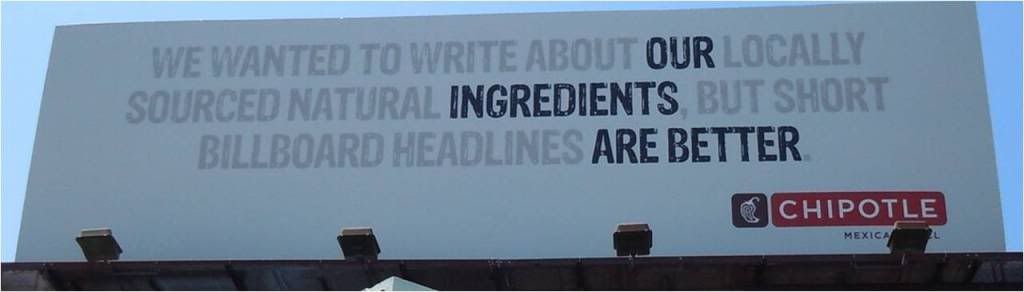
So have you seen those Chipotle billboards? Or well... have you noticed the new Chipotle billboards? You may have seen, but had a rough time really noticing the message. Rather than an over-sized foiled burrito with a short, clever phrase, the new creative is a very lengthy description (in regards to standards on content in billboard campaigns) in gray text with a few words in darker letter and the Chipotle logo in color in the corner. On a quick glance it may read as something like, "We make big burritos." 


Was I more attuned to this only because about the time these popped up I was in the middle of trying to convince people involved in a billboard campaign that less is more? Most likely; the irony (on many levels) had me laughing on my commute to and from work. Regardless, it got me thinking about the success of these "meta" campaigns and also what agency would take on this project only to take a beating. 


This article in the New York Times informs that it really wasn't an ad agency willing to let Chipotle bash them in this campaign. The campaign was built in-house... but they were making light of all the advice given by former ad agencies. Hmm... maybe Chipotle just didn't look hard enough for an agency to fit their culture. Looking into other meta campaigns like the Donato's yes-we-sucked-but-now-we-don't, we find Crispin Porter and Bogusky behind that brainchild--an agency known for its quirky ads like the Whopper Freakout when consumers were told they couldn't get a Whopper on a hidden camera.


But thinking on Chipotle and Donato's "meta" campaigns it takes me back to my Movie Musicals courses and discussing self-reflective musicals (a musical that portrays others putting on a musical). It was suggested by Jane Feuer that these type of musicals hold a myth of the audience which when we see the audience in the musical reacting in a certain manner, we as the actual audience react in the same manner. So, as we watch these "Domino's hold outs" give in to trying the new Donato's pizza and loving it, we are wanting to give in and love it as well. Plus for many, as they heard the feedback in the focus groups in the first run of commercials for the campaign regarding the lacking old pizza, it was reinforcement of an opinion you held and forced you to listen as you felt a personal connection as to how those shared concerns would be addressed. As for Chipotle's meta campaign not having an audience to connect with, in my humble, yet somewhat biased towards the advertising (agency) industry, opinion, I think it makes them sound pretentious.  In saying that, these campaigns reflect another musical trait, camp, which many define as being ostentatious... I suppose the route on which Chipotle was headed.


Whether or not Chipotle's meta campaign is being viewed as they would hope or as I see it, it is important to note that most any brand properly involved in social media is in some ways involved in a meta campaign. Having your consumers have a very public place to address their concerns with your product/service and needing to provide a quick response to them requires some self-reference and an ability to give a voice to your brand. Social media is the meta-campaign without all the parody... although depending on whom you have managing the content for your social media, could still be quite campy.


Other References
Feuer, Jane. "The Self-Reflective Musical and the Myth of Entertainment." Hollywood Musicals: The Film Reader.
"Like Cardboard." - Seth Stevenson

Wednesday, June 23, 2010

Targeted online advertising, a thing of the future for some, soon to be the past?

I'm too cheap to buy a subscription to Women's Wear Daily which is upsetting since I'd love to read more on their article titled "Fashion Brands Rush to Web but Not to Advertise." I'd love to know the reason as to why they are choosing to update websites and engage in social media, but not advertise. 


What made me so interested in why they are not jumping on the opportunities for online advertising is reading more updates on the future of online advertising. While online ad spending is increasing (see graph from eMarketer.com article), the business of targeted ads has a bleak future. Don't get me wrong... I stand by my targeted campaigns as through mine I've maintained above average click-through rates (CTR), according to results by Eyeblaster's Research Global Benchmark 2010. Alas, the days of targeted ads and the ability to analyze your online advertising media's demographics and traffic through sites like Quantcast may be few and far between as PRIVACY keeps getting called into question. 


A group of industry leaders are pushing to set standards on companies that track user's online habits and behaviors so that the issue is contained without government regulations. The initiative was started last summer with Seven Regulatory Principles for Online Behavioral Advertising. With the goal of the principles to make consumers aware, educate and eventually offer privacy options, I don't see how much progress has been made when as an advertiser--someone with a real investment in this--I'm hardly hearing much on this. Of course as an advertiser I don't want to lose targeting, but as a consumer privacy is important. Regardless of the consumer-advertiser dichotomy, not much has been said or implemented to either party. So, I can only guess the FTC is breathing down the necks of these ad targeting companies and regulation changes are imminent... 


So now I come back to the main question... fashion brands why NOT take advantage of  this successful marketing tool before it is changed (much more so than with advents of technologies)? If that WWD article has the answer to this, please, do share! 


Other sources:


US Online Advertising Spending as a Percent of Total Media Advertising Spending, 2008-2014


To Stem Privacy Abuses, Industry Groups Will Track Web Trackers

Monday, June 14, 2010

Forgo the craze and get creative

I'm incredibly interested in the new trends in digital marketing and advertising; yet, this article below got me thinking about the benefit of sticking to traditional media. In an older post, I had mentioned how Olay and Proactiv really thought about what traditional advertising meant for them and how to break out from it. Now I've got to thinking this... as everyone else is breaking out of traditional media in the terms of traditional vs new/digital media maybe it is the time to stand out in the old arena! 


Thinking back to my radio sales days, I started out helping to sell spots and then turned into handling only new media ads... and boy were there a lot of different ones and a lot more the station group was hoping to offer. So the media is changing to focus on digital advertising as the thought is that advertisers want to move into that. Wouldn't that mean those old spots aren't getting as much attention and would be selling for less and to less people? Increase your reach and your frequency! 


So with that money you are saving on your spot, you can put in some dough to developing really interesting campaigns. But better yet, if you are focusing on traditional media and don't spend all that time @replying to every customer whom tweets about your product/service then you have the time to build some amazing creative.  


Another way to break through the clutter... don't jump on the bandwagon of clutter! In saying all that, I'd still recommend focusing some time and money in digital as having a true marketing mix to cover all different channels really helps your reach!

Dwindling Brand Creativity Narrows Cannes Film Predictions

Wednesday, June 9, 2010

Generation-spanning branding is no new thing

After having posted my last blog about the glaring differences in buying attitudes and practices from generation to generation, I found the below headline quite catching. The author suggests that with brands like Starbucks, Pinkberry, Ugg and Twilight we are entering a “new reality” in advertising and brand building.

One commenter suggested that most of the aforementioned brands really just denote social power which everyone tries to buy into regardless of age. Yes, some people buy into Starbucks for the assumed status it gives them over their 99-cent-convenience-store-coffee-drinker counterparts. I believe Starbucks really has a more alternative brand built around the music and art and environmental projects it supports, but those associations bring a sort of high-class cultured status to Starbucks image. I don’t believe it was Starbuck’s intent to market to everyone, but in marketing to what most everyone believes is status quo they have done so.

On another note, I’d like to argue that this is not at all a new reality. I’m pretty sure Hasbro played out the family game night campaign long before the advent of video games.  Since parents must support the brands their children buy into, toys and activities have always reached parents and kids alike.  After all, a child can say I want, I want, I want but it is up to the parents to literally buy into the brand. Take for instance, Disney. Who doesn’t want to go to the happiest place on earth? As much as kids love the characters and storylines, adults do too. For more than 20 years we’ve been hearing our favorite superstars tell us that what’s next for them is going to Disney!

Disney, Starbucks and the like haven’t had it easy. I have to agree it does take a great understanding of what your brand is and making it clear to your consumers in order to reach everyone. However, it is entirely important to note how building a status around your brand helps in reaching any generation. Also, new media or innovative advertising and branding hasn’t made this possible; we have established brands that appeal to the masses and have been for years.  If brands didn't appeal to multiple generations the reality would be that your target generation would take your brand to their grave... yikes.


What Generation Gap?

Sunday, June 6, 2010

Media Buying BEWARE!

Having helped to create sales pitches for radio advertising, I'm quite familiar with the "key demographic." That demographic being women age 25-44--the person with the most buying power in families. We've all heard the recession buzz phrases about spend-savvy consumers, recessionistas and the new normal. As consumers, we may have developed these spending personas, but as advertisers we have to be even more aware of this change. The new demographic to be targeting isn't that 25-44 demographic anymore. It is GenY whom haven't felt much of the change from the recession and will continue spending as normal. They will buy into the new technologies that will arise from the recovery while older generations will more likely keep to the spending habits they formed when money was tight (which includes holding on to older technologies until necessary to upgrade). You will find media readjusting those sales pitches I had worked on in the past and see advertisers finding ways to reach the young, tech-friendly generation. My suggestion: focus on online advertising. My online campaigns have had tremendous success, and I think it will only continue growing. In an industry that doesn't relate to this demographic? Continue with the couponing, sales promos, etc until people forgo these habits, which I believe will happen as soon as unemployment numbers dwindle again.