
Showing posts with label seo. Show all posts

Wednesday, October 9, 2013

The Elusive ROI of Social Media

Social media ROI doesn't have to be elusive. Seriously.

Google Analytics has recently made it even easier to measure it. I promise.

Rather than seeing traffic sources you can now see "Acquisitions." Upon clicking on that head to "Channels" where your view should default to the default channel grouping. These are your sources such as, organic search, direct traffic and what do you know SOCIAL!

When you click on the social grouping you will see this beautiful table below.


  1. Set up your goals
  2. Apply a value to each
  3. Take your "goal value totals" - "your costs for social media (salary/rates for a community manager maybe, social ads, etc)"/"cost"

VOILA ... you have social media ROI!

Ok, Maybe It Isn't That Easy

Not in a bad way there is another factor that should be taken into account. Social sharing plays hugely into search engine optimization (SEO) [insert plug to post from a couple weeks ago about that exact topic] . From that default channel grouping you can review the same dashboard as above for your Organic Search and see how that also affects your goal values. This isn't to say social completely plays into your Organic Search, but it is a big driver.

AND we also have to think about the fact that someone may already be a customer, reached out on social media, had a pleasant experience and continues coming back (not necessarily through social channels) that can add to your ROI. Again, can't note that through Google Analytics, but I bet it happens. 

Who's with me that we should add an additional 20% to the values indicated above? Just kidding. Don't do that, but do be sure to mention to execs how SEO and brand/reputation building aspects of social media are valuable too!

Tuesday, October 1, 2013

Oh Search, It is A-Changing


Do you remember a time when you may have put in a search term like "rain bucket" and gotten search results that didn't necessarily speak to a bucket that catches rain but maybe one or the other? So then you try different words, variations on phrases, etc? And how about trying to just find a number to contact someone about buying a rain bucket? Oh how far search has come.

Search is Smarter

With technology like that which built Watson - the computer that defeated some champions at Jeopardy!, the way Google performs has changed too. First came the knowledge graph and just recently announced is Hummingbird. Which according to this piece in the New York Times, the changes made for Hummingbird are because "Google users are asking increasingly long and complex questions and are searching Google more often on mobile phones with voice search."

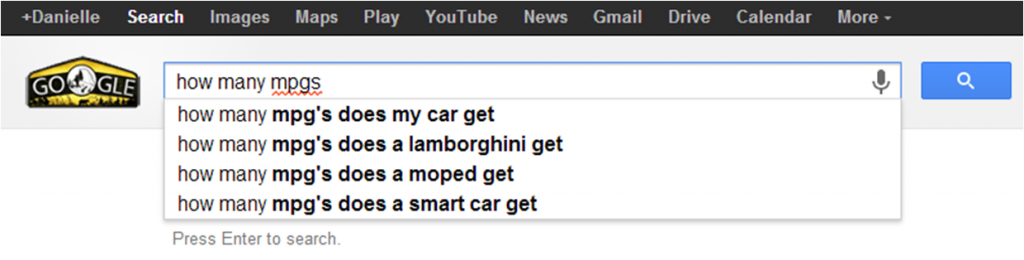
Thanks to those lovely Apple commercials featuring some of our favorite celebrities and Siri, we expect to ask a question and get an answer. Rather than asking for a specific make and model of car and then finding what looks like a reputable site to find out the MPGs, we simply ask "how many mpgs does [insert make and model] get." (Maybe one day Google will even be able to pull up your actual car if you enter the first search phrase listed in the picture above - creepy but not likely very far off with the amount of data it collects on us).

Google says marketers only need to stick to original, high-quality content for SEO efforts with Hummingbird.

Search is More Efficient (sort of)

With the knowledge graph also came information directly in your search results, such as birth dates of public figures and similar people. Per the statement about the Hummingbird release, users are searching often on mobile phones and finding information directly in the search results can prove much more efficient then browsing to a possibly-not mobile friendly site to find a phone number. 

70% of smartphone users would agree. According to a survey of 3,000 smartphone users, 70% have used the click to call function in Google's mobile search results and 59% of them do it to "quickly" get a response/answer.

Only problem is that Google Places still can pull incorrect information and the click-to-call function just gets really frustrating for users and the business owners. I work in healthcare and this is a huge problem for hospitals with locations inside of locations. More on that, if you'd like.

This change makes it more important to be using Google Places for Locations and keeping Google+ business profiles updated.

Monday, September 23, 2013

WDF*P*IDF ... WTF?: A lesson in search engine optimization

If you work in public relations or communications, I hope you didn't have a huge conniption several weeks ago when Google supposedly killed PR. PR wasn't killed; only shady tactics to get backlinks were. Web addresses can still be listed in press releases, but must have a "rel=nofollow" tag. And you know what - it still can help your search engine optimization (SEO)!

When you think of SEO do you think of backlinks and/or keywords? I did back when I first got a lesson on SEO in March of this year. Keywords, backlinks and keyword density (indicated as the formula WDF*P*IDF or within-document-frequency's correlation to number of instances of a keyword in all other relevant documents in the underlying database) were big chunks in the SEO ranking factors. Not a bad mix of off-page (backlinks) and on-page (keywords) factors. But then Penguin 2.0 came out in May and Panda has been updating pretty regularly.

Google Takes Care of Google


Remember all those jokes about Google+ only being for Google employees? Well joke is on all of us.

From this great graph in Search Metrics "SEO Ranking Factors - Rank Correlation 2013" (released June 20, 2013)  it is pretty plain to see that social (in the orange) has a much higher impact than most other backlinking and all on-page factors. And surprise, suprise Google+ is numero uno!

Back to that nofollow tag though, it is right up there above all of the on-page factors now too.


And that's not all, now SEO experts think they have cracked the code to the new Google search carousel, and Google+ reviews (rating and quantity) seem to correlate to getting listed there! More on that from DigitalMarketingWorks.com

What Can I Do?


  • Have your social profiles linked on your website
  • Use Google+
  • Use Google Places for Business
  • Continue getting your website listed (with the appropriate nofollow tag) on relevant sites that have similar or slightly higher ranking than you.
  • Pay attention to your review sites! Don't be shady and start buying up reviewers (Yelp is already on to you). Believe me it will happen, and Google will have to change all their algorithms again. If you are that shyster that causes the next "Google Killed PR" debacle, every person in SEO will hate you. Don't be the SEO shyster.